Refund rules confuse a lot of travelers. Here is when you are owed money back, and how to actually get it.
Part of our complete guide to airline customer service.
Quick answer: If the airline cancels or significantly changes your flight and you decline the alternative, you are owed a cash refund to your original payment method — even on a non-refundable ticket.
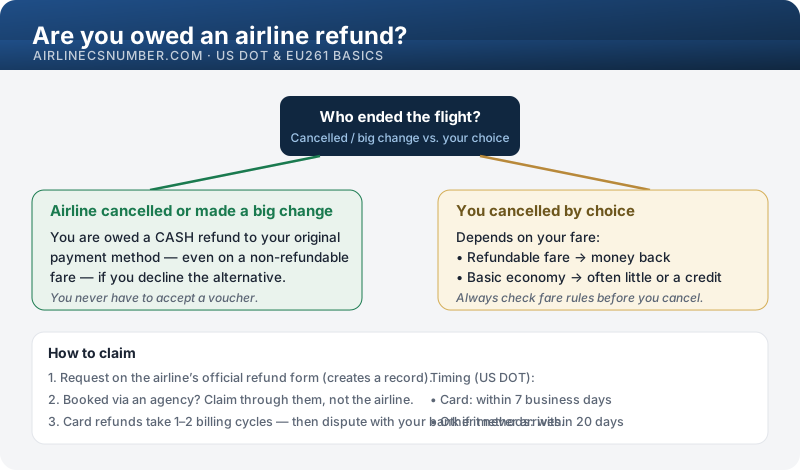
When you are entitled to a refund
You are generally owed a refund — even on a non-refundable ticket — when the airline cancels your flight, makes a significant schedule change, or delays you substantially and you choose not to travel. In the United States, the Department of Transportation requires airlines to give a cash refund in these cases if you decline the alternative; you are not obliged to accept a voucher. Many other countries have similar passenger-protection rules.
Refund vs. travel credit
Airlines often push travel credit or vouchers because the money stays with them. A credit can be fine if you fly that airline often, but a refund to your original payment method is usually the safer choice. If you are entitled to a refund, ask for the refund explicitly — agents may offer credit first.
Voluntary changes
If you simply change your mind, what you get back depends on your fare. Refundable fares return your money; basic-economy and other restricted fares often return little or nothing, or only a credit minus a fee. Always check the fare rules before you cancel.
How to claim
- Start the request on the airline’s official website — most have a refund form. This creates a record.
- If you booked through a travel agent or online travel site, claim through them, not the airline.
- Note your refund request number and ask for written confirmation of the amount.
- Card refunds usually take one to two billing cycles. If it does not arrive, follow up, then dispute the charge with your card issuer.
Avoid refund scams
No legitimate airline charges a fee to process a refund, and a real refund always goes back to your original payment method. Anyone asking for a fee, a gift card, or your full banking login to “release” a refund is a scammer.
Worked example: cancelled non-refundable ticket (US)
Say you paid $214 for a basic-economy fare and the airline cancels the flight the night before. It offers a seat on a flight the next afternoon. The trip no longer makes sense, so you decline. Under the DOT rules, you are owed the full $214 back to your card — taxes and fees included — automatically and in cash, even though the fare was “non-refundable.” The airline may offer a voucher first, sometimes a larger one. You can take it if it suits you, but you never have to.
How long refunds actually take
Under US rules, card refunds must be processed within seven business days and other payment methods within twenty calendar days; expect the credit to appear within one or two card statements. If you booked through a travel agency or booking site, the refund flows through them — same entitlement, sometimes slower. A refund that hasn’t appeared after two statements deserves a follow-up.
If the refund never arrives
Keep your request number and any confirmation email. Chase the airline once in writing. If that goes nowhere, dispute the charge with your card issuer — cite the cancelled flight and the DOT automatic-refund requirement — and file a complaint with the Department of Transportation’s aviation consumer protection office. Card disputes over documented cancelled flights are routinely decided for the passenger.
Frequently asked questions
When am I entitled to an airline refund?
When the airline cancels, significantly changes, or substantially delays your flight and you choose not to travel — even on a non-refundable ticket. US rules require a cash refund to your original payment method in these cases.
Can I get a refund on a non-refundable ticket?
Yes, if the airline caused the disruption (cancellation or major change) and you decline the alternative. If you cancel by choice, a non-refundable fare usually returns little or only a credit.
How long does an airline refund take?
US rules require card refunds within 7 business days and other methods within 20 days once approved. In practice, card refunds often show within one to two billing cycles.
Should I take a refund or a travel credit?
A refund to your original payment method is usually the safer choice. Credit can be fine if you fly that airline often — but if you’re owed a refund, ask for the refund explicitly, as agents may offer credit first.